
Table of Content
Aerodynamics
Meteorology
- Troposphere (tropos (meaning
“turn, turn toward, change”) and sphere (as in the Earth))
- Tropopause
- Isotherm
- Inversion
- Boden- vs. Höheninversion
- Taupunkt
- Adiabatischer Temperaturgradient (°C/m)
- Warum nimmt die Temperatur mit der Höhe ab?
- Treibhauseffekt (kurzwellige & langwellige Strahlungen)
- Passat
- Jetstream
- Hoch & Tiefs
- Innertropische Konvergenzzone
- SwissTopo
- https://shop.swisstopo.admin.ch/en/products/free_geodata
- https://www.swisstopo.admin.ch/de/home/meta/medieninformationen.detail.news.html/swisstopo-internet/news2021/news_release/20210301.html
- https://paraglidingearth.com/
- https://www.dwd.de/DE/leistungen/opendata/opendata.html
- https://opendata.dwd.de/
- Typische Wetterlagen im Alpenraum

Air
- Pressure is higher the closer the air is to the earth/bottom
- Air expands when heated up. Therefore,
- density of colder air is higher than of warmer air
- warmer air raises up whereas colder air sinks
- Heat is given to surrounding when steam condenses to water or when water freezes into ice
- Heat is taken from the surrounding when ice melts to water or when water evaporates to steam
- air humidity
- absolute is in g/m³
- relative is in % (proportion of absolute and maximal humidity)
- Temperature gradient tells how much the air changes its temperature when
raising resp. sinking
- dry adiabatic: 1°C/100m (heat up when sinking = cooling down when raising, rel. humidity < 100%)
- humid adiabatic 0.6°C/100m (when raising), 1 °C/100m when sinking, rel.
humidity > 100%)
- 0.6 is due to the fact that rel. humidity > 100% and therefore steam condenses (at the dew point) which releases heat to its surrounding
- labile & stable layers
- advection: horizontal transport of some property (e.g. heat, humidity) of the atmosphere
- convection: vertical transport (vertical advection)
- temperature inversion: Usually higher air is colder than lower air. If warmer air is above colder air, it is an inversion. The temperature gradient is positive (e.g.: 1°C/100m).
- Isothermie: The temperature gradient is 0°C/100m
- Luv- und Leethermik
- Umkehrthermik
- Rückseitenwetter
- Kalt- und Warmfrontokklusion
- Warmsektor
- Turbulence Types
- Low-level turbulence (LLT)
- Mechanical: a LLT that results when airflow is hindered by surface
friction or an obstruction. It occurs because friction slows the wind in
the lowest layers causing the air to turn over in turbulent eddies which
can cause fluctuations in winds and vertical velocities.
- wind shear
- Windscherung scherungsbedingte: sich zwei benachbarte Luftmassen in verschiedener Richtung und/oder mit verschiedener Geschwindigkeit verschieben und sich dabei aneinander reiben.
- Thermal: a LLT produced by dry convection. Typically, a daytime phenomenon, it occurs over land under fair weather conditions. As solar radiation heats the ground during the morning and afternoon generating thermals that move away from the ground, creating chaotic patterns that produce LLT.
- Mechanical: a LLT that results when airflow is hindered by surface
friction or an obstruction. It occurs because friction slows the wind in
the lowest layers causing the air to turn over in turbulent eddies which
can cause fluctuations in winds and vertical velocities.
- Turbulence near thunderstorms (TNT)
- Clear-air turbulence above 15,000 ft (CAT)
- Mountain wave turbulence (MWT)
- Low-level turbulence (LLT)
Clouds
[Level][form]
https://whatsthiscloud.com/

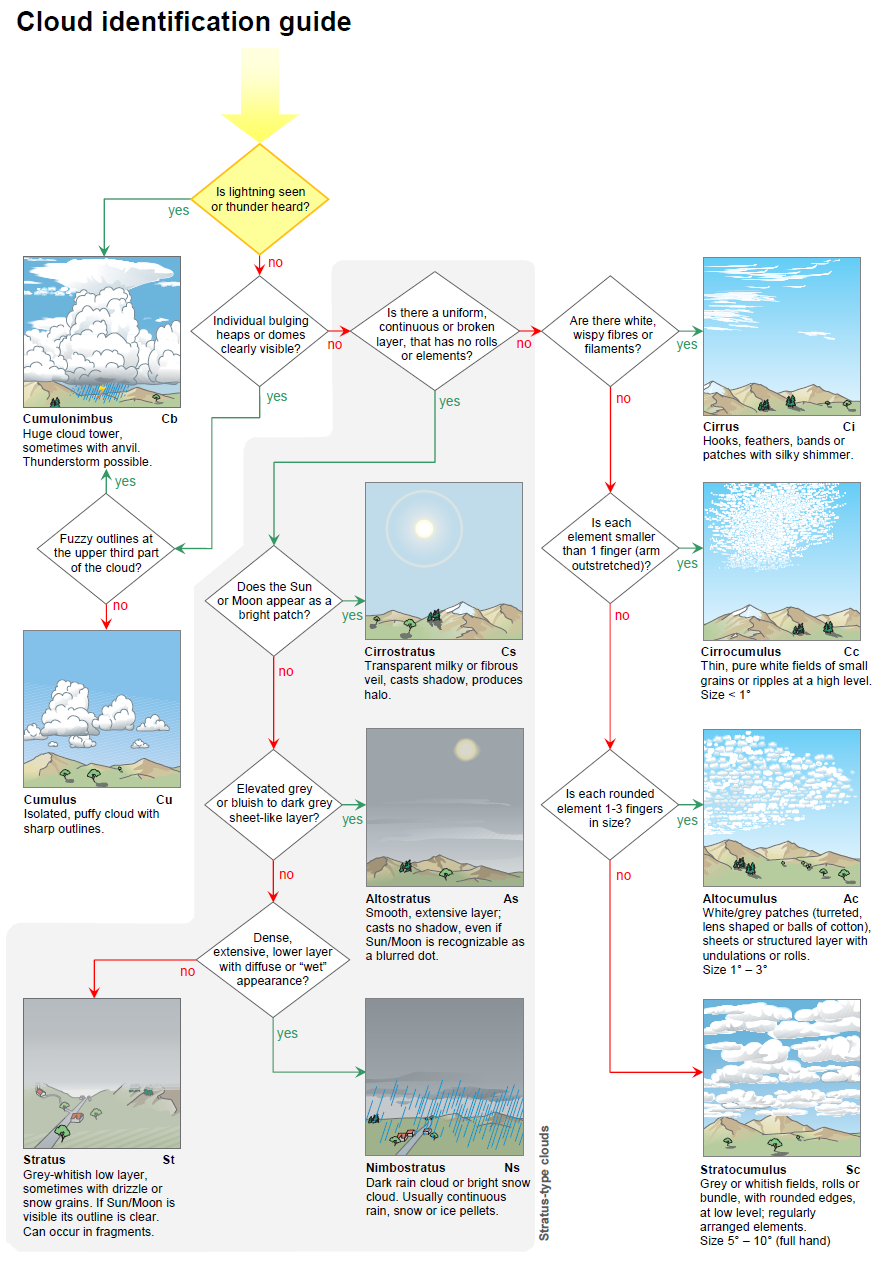
Form/Shape
- Cumulus (Anhäufung)
- Stratus (ausdehnen, ausbreiten, Schicht)
- Cirrus (Haarlocke)
Level/Height
- Cirro (high)
- Alto (medium)
- Strato (low)
Main cloud types
- Cirrus (Ci, unterteile Schichtwolke)
- Cirrocumulus (Cc, unterteile Schichtwolke)
- Cirrostratus (Cs, Schichtwolke)
- Halo possible
No self-schadow
- Altocumulus (Ac, unterteile Schichtwolke)
- Altostratus (As, Schichtwolke)
- No Halo
- Nimbostratus (Ns, Schichtwolke)
- Stratocumulus (Sc, unterteile Schichtwolke)
- Stratus (St, Schichtwolke)
- Cumulus (Cu, Quellwolke)
- Cumulonimbus (Cb, Quellwolke)
- virga (Zweig): precipitation which doesn’t touch ground
- incus (Amboss)
Beobachtungshandbuch
Chapter 6.1
Warme Luftmassen können mehr Feuchtigkeit (Wasseranteile) als kalte Luftmassen.
Beobachtet man an einem kalten Wintertag draussen seinen Atem, stellt man manchmal fest, dass die ausgeatmete Luft sichtbar wird. Das gasförmige Wasser in der Atemluft kondensiert zu kleinen Wassertröpfchen, weil sich die ausgeatmete Luft in der Umgebungsluft soweit abkühlt, dass sie nicht mehr die gleiche Menge Wasser in gasförmigem Zustand behalten kann. Kalte Luft kann weniger gasförmiges Wasser behalten als warme Luft. Wenn die Umgebungsluft nicht genügend kalt ist, kommt es nicht zur Kondensation des gasförmigen Wassers. Der Atem bleibt unsichtbar. Ähnlich verhält es sich bei der Wolkenbildung: Aufsteigende Luft kühlt sich ab, und ein Teil des gasförmigen Wassers kondensiert zu winzig kleinen sichtbaren Wassertröpfchen, die bei entsprechenden Temperaturen zu Eiskristallen gefrieren. Es entstehen Wolken aus Wassertröpfchen oder Eiskristallen.
Three ways how cloud form
- thermal (sun warms up the air and therefore lets it rise)
- orographic (due height structure of earth air gets pushed up)
- frontal (warm & cold front)
Cloud base: bottom of the cloud where air cooled down enough so that humidity is 100% and water condenses and therefore first droplets start to build.
Hydrometeore
Photometeore
Width of a cloud
- 1 degree = small finger of outstretched arm
- 5 degree = fore, middle & ring finger
Wind
- 20 knots ~= (2x20) - 10% = 40 - 4 = 36km/h
- 270/10 = Wind coming from west (270°) blowing to the east with ~18km/h
- wind moves from low pressure (turns counterclockwise) to high pressure (H, turns clockwise)
Coriolis force
Thermals
Thunderstorm
Meteo Briefing
- Danger/Reason why NOT to fly
- Gewitter
- Wind
- Föhn
- Fronten
- Windy
- Burnair.ch - wertvolle Links
- Meteo Centrale - Föhn & Bise
- Emagramm
- Explanation
- https://youtu.be/DY5Tw8hDurY
- https://meteo-parapente.com/
- https://www.windy.com/sounding/47.314/8.478?47.168,8.527,11,m:eX0agph
Law
| Klasse | max. Höhe | Aufsicht | Einflug | Wolkenabstand | Sicht | Flugart |
|---|---|---|---|---|---|---|
| C | kontrolliert | Freigabe & Funk | ↔︎1.5km ↕︎300m | 8km | VFR & IFR | |
| D | kontrolliert | Freigabe & Funk | VFR & IFR | |||
| E | FL100 (3050m)¹ / FL130(3950m)²ª / FL150 (4550m)²ᵇ | kontrolliert | frei | ↔︎1.5km ↕︎300m | 5kmᴬ/ 8kmᴮ | VFR & IFR |
| G | 600m | unkontrolliert | frei | ↔︎1.5km ↕︎300m | 5km | VFR & IFR |
| G | 300m | unkontrolliert | frei | keine | 1.5km | VFR |
1] Jura/Mittelland @ 1013.25hPa
2] Alpenraum @ 1013.25hPa
a] MIL ON
b] MIL OFF
A] unterhalb FL100
B] oberhalb FL100
- DABS (Daily Airspace Bulletin Switzerland): today tomorrow
- NOTAM (Notice to Air Man)
- Segelflugkart (GLDK)
- VLK - Verordnung des UVEK über Luftfahrzeuge besonderer Kategorien
- SHV Luftraumbroschüre 2021
- ATC (Air Traffic Control)
- ICAE (International Civil Aviation Organization)
- ICAO Airspace classes (A - G)
- CTR (Controlled Traffic Region) - Kontrollzone
- TMA (Terminal Manoeuvring Area) - Nahverkehrsbereich
- MIL ON (Militärflugdienstzeiten: Mo-Fr 7:30-12:05 & 13:15-17:05 or NOTAM)
- MIL OFF (ausserhalb Militärflugdienstzeiten)
- RMZ (Radio Mandatory Zonen)
- AWY (Airway) - Luftstrassen
- IFR (Instrument Flight Rules) - Instrumentenflug
- VFR (Visual Flight Rules) - Sichtflug
(eVFR Manual/guide)
- VMC (Visual Meteorological Conditions)
- LS = Switzerland according to ICAO Code
- LS-D (Danger) - Gefahrengebiete
- LS-R (Restricted) - Flug-/Luftbeschränkungsgebiete
- LS-P (Prohibited) - Sperrgebiete/Flugverbotszonen
- AGL (Height Above Ground Level)
- AMSL (Height Above Mean Sea Level)
- FL (Flight Level, expressed in hundreds of feet) - FL-195 ≃ 195 x 0.3 x 100 = 5950m.ü.M @ 1013.25hPa (but depends on pressure, i.e. if current pressure > 1013.25hPa then > 5950m)
- GND (Ground)
- H24 - Continuous day and night service, continuous round-the-clock operation (region is always active)
- HX - Not Permanently Active; No specific working/operational hours, can be activated within 30min
Material Science
- Ripstop fabric are woven fabrics, often made of nylon, using a special reinforcing technique that makes them resistant to tearing and ripping. During weaving, (thick) reinforcement yarns are interwoven at regular intervals in a crosshatch pattern.
- Porosity is the measurement of the amount of time it takes for a certain volume of air to pass through the paraglider canopy fabric.
- Crossports (Druckausgleichsöffnungen) are openings in the wall of a cell
and allow good air distribution and pressure equalization within the wing and
increases the stability of the glider. I.e. air can be diverted into the
stabilo of the wing.

- Rope splicing
- Trimmspeed is the speed of the paraglider in its unbraked state.
- Aufhängehöhe is the height (cm) measured from the carabiner to the seating area
- EN Certification Test
Flight Practice
- Atmospheric pressure (QFE, QFF, QNH)
- Digital Glider Map
- DABS - Daily Airspace Bulletin Switzerland
- NOTAM - Notice to Airmen
- Training Check List
- 5-point-check
- 3-phase-start
- Gurtzeug
- Fähigkeitsprüfung für Hängegleiter-Piloten
Will Geordie Have His Cat Aboard Today.
W - Wind and Weather
G - Glider
H - Helmet
H - Harness and Reserve pin
C - Controls
A - All Clear
T - Turn direction
Further Reading
- http://skynomad.com/paragliding_articles.htm
- https://www.papillon.de/fliegerhandbuch-paragliding-today.html
- Flugschule Oberbayern - Gernot Brabänder
App
- Foehn index
- Visual Observations
- Wind speed & gust
- Humidity 10min
- Pressure
- Aviation
- obstacles
- Airspaces (CTR, TMA)